
Table of Contents
Who is Bobby Tables?
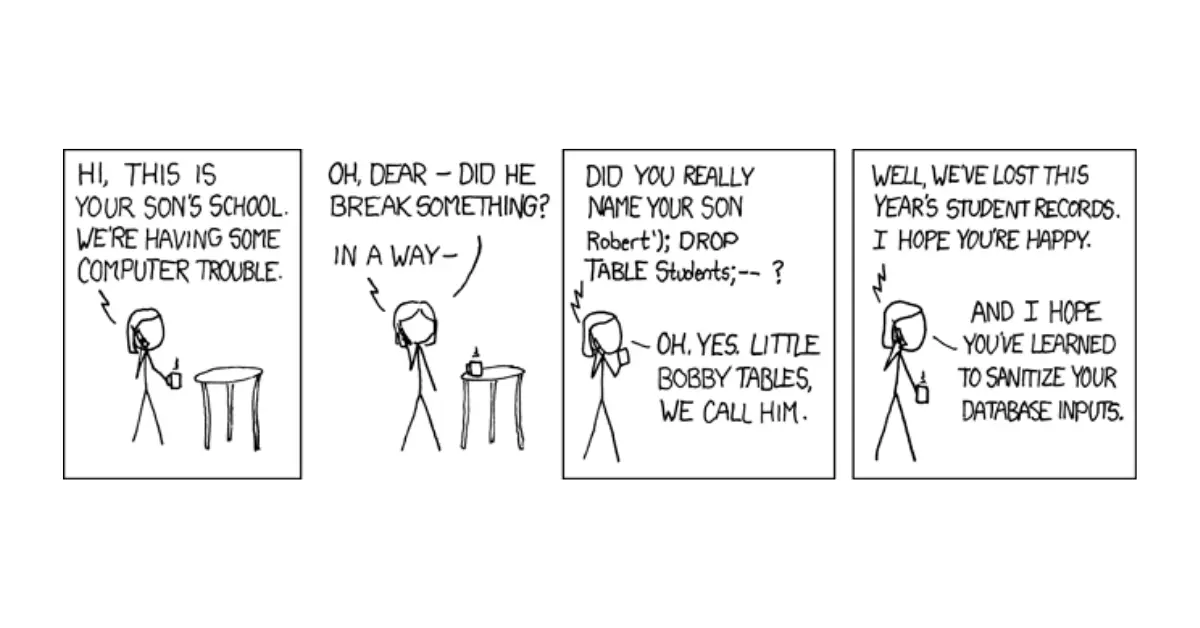
Bobby Tables is the nickname for a fictional child in the xkcd comic “Exploits of a Mom.” The comic is widely used in programming and cyber security education to explain SQL injection in a simple, memorable way.
The joke works because the child’s name is written like database command text. It teaches an important secure-coding lesson: applications should never treat user input as executable SQL.
Bobby Tables and the xkcd Comic
Bobby Tables comes from the xkcd comic “Exploits of a Mom.” The comic is often referenced as “Little Bobby Tables” because it turns a database security mistake into a memorable joke. This page does not need to reproduce the comic text to explain the lesson: applications must treat user input as data, not executable SQL.
Why is it called Little Bobby Tables?
The phrase Little Bobby Tables comes from the popular xkcd comic where a child’s unusual name is used to explain unsafe SQL query construction. Many developers use “Bobby Tables” as shorthand for SQL injection caused by mixing user input with database commands.
What the xkcd Bobby Tables Comic Teaches About SQL Injection
The Bobby Tables example explains how a database query can become unsafe when developers combine user input and SQL code as plain text. If an application does not separate data from commands, specially crafted input may change the meaning of the query.
For beginners, the most important takeaway is not the exact comic text. The important lesson is that user-controlled input must be handled as data, validated where appropriate, and passed to the database through safe APIs.
Bobby Tables vs Real SQL Injection Risk
| Search phrase | What users usually mean | Safe lesson |
|---|---|---|
| Bobby Tables | The SQL injection teaching example | Separate SQL code from user input |
| Little Bobby Tables | The same xkcd character/reference | Use parameterized queries |
| Bobby drop tables | The database joke/action reference | Do not concatenate raw input into SQL |
| xkcd SQL injection | The original comic concept | Use secure database APIs |
Why String Concatenation is Dangerous
String concatenation becomes risky when a query is created by joining SQL text with raw request values. The database cannot reliably know which part is intended as code and which part is only user data.
SQL injection can affect login forms, search fields, filters, admin panels, report builders, and APIs. Related learning includes the main SQL Injection Attack guide, Second-Order SQL Injection, and Parameter Tampering Attack.
Safe Defensive Pattern
A safer pattern is to use parameterized queries or prepared statements. The exact syntax changes by language and database library, but the principle is the same: SQL code and user-supplied values stay separate.
// Safer pattern: use a parameterized query
const user = await db.query(
‘SELECT * FROM students WHERE name = ?’,
[request.body.name]
);
This approach tells the database that the submitted value is data, not part of the SQL command. It should be combined with least-privilege database accounts, safe error handling, and careful validation for dynamic query parts.
The same principle applies across languages and database libraries: keep SQL structure fixed and pass user-controlled values separately. For dynamic identifiers such as sort columns, use an allowlist rather than raw user input.
Common Mistakes After Learning Bobby Tables
- Escaping input manually instead of using parameters.
- Using prepared statements for values but not safely handling dynamic table or column names.
- Trusting ORM raw-query helpers without reviewing interpolation.
- Giving the application database account more privileges than it needs.
- Showing raw database errors to users.
- Testing only login forms while ignoring search, filters, reports, and admin tools.
Bobby Tables Prevention Checklist
- Use parameterized queries or prepared statements for database access.
- Avoid building SQL commands by string concatenation.
- Use ORM/query-builder features safely, without raw unsafe interpolation.
- Allowlist dynamic table names, column names, and sort directions if they must be user-controlled.
- Use least-privilege database accounts for applications.
- Do not reveal raw database errors to users.
- Test applications for SQL injection during authorized security reviews.
- Review related input-handling risks such as input validation attacks and XSS vs SQL injection.
FAQs
Who is Bobby Tables?
What is the original Bobby Tables comic called?
Why is Bobby Tables used to explain SQL injection?
What does Bobby Tables mean in SQL injection?
Is Bobby Tables only about login forms?
How do parameterized queries prevent SQL injection?
Summary
Bobby Tables is a memorable way to learn SQL injection risk. The defensive lesson is clear: separate SQL code from user input, use parameterized queries, validate dynamic parts, and design database access with least privilege.